Understanding Australian Sustainability Reporting Standards: AASB S2
Growing investor and regulator demand for credible, decision-useful sustainability reporting has shifted Australia’s climate disclosure regime from a “proposal” into an active and enforceable legal requirement. Since the first article in this climate-related financial reporting series, the framework has progressed significantly: legislation has been enacted, climate disclosure standards have been issued by the Australian Accounting Standards Board (AASB), and ASIC has released Regulatory Guide 280 (RG 280), clarifying how the regulator will supervise Australian sustainability reporting and what it expects directors and reporting teams to do in practice.
This article details where Australia’s climate-related financial disclosure regime has landed, defines the specific thresholds for liability (Groups 1, 2, and 3), and outlines what certain entities must do to comply with the mandatory sustainability reporting standards now embedded in law.
What has changed since the proposal stage?
The legislative framework has been enacted
Australia’s mandatory sustainability reporting regime is now fully operational. The Treasury Laws Amendment (Treasury Laws Amendment (Financial Market Infrastructure and Other Measures) Act 2024) received Royal Assent on 17 September 2024. This legislative instrument amends the Corporations Act 2001 to mandate environmental sustainability reporting for in-scope entities (those required to disclose climate-related financial information), establishing formal sustainability disclosure obligations as part of their annual reporting.
New standards have been issued
The Australian Accounting Standards Board has finalised the Australian Sustainability Reporting Standards (ASRS):
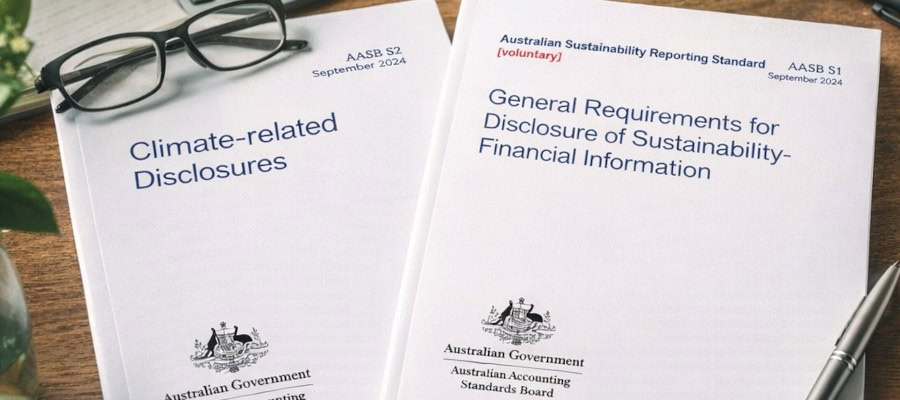
- AASB S1 (General Requirements): AASB S1 is the voluntary standard that entities can elect to apply. AASB S1 sets the baseline requirements for sustainability disclosures, so investors can understand an entity’s sustainability-related risks and opportunities when making resource-allocation decisions.
- AASB S2 (Climate-related Disclosures): AASB S2 is the primary mandatory standard for in-scope entities. It sets out the requirements for the disclosure of information of an entity’s climate-related risks and opportunities.
Together, these standards form the basis of Australian sustainability reporting and create a coherent structure for climate related financial disclosures and sustainability related financial information.
Additionally, ASSA Auditing Standards have been released, including:
- ASSA 5000 General Requirements for Sustainability Assurance Engagements, which provides requirements for the audit and review of the information in a sustainability report and for assurance over sustainability information prepared for other purposes.
- ASSA 5010 Timeline for Audits and Reviews of Information in Sustainability Reports under the Corporations Act 2001, which specifies the information in sustainability reports that is to be subject to audit and/or review for each financial year commencing before 1 July 2030.
Sustainability reporting requirements have commenced for Group 1
The sustainability reporting requirements began on 1 January 2025 for the first cohort of reporting entities (Group 1). The obligations apply to entities required to lodge financial reports under Chapter 2M of the Corporations Act 2001.
Implementation is phased across reporting periods. Entities must assess themselves against the relevant thresholds to determine their commencement date, based on financial years starting on or after the specified dates.
An entity falls into a Group if it meets two of the three criteria below:
- Group 1 (commenced 1 Jan 2025):
- consolidated revenue: > $500 million
- consolidated gross assets: > $1 billion
- employees: > 500
(Note: Large National Greenhouse Energy Reporting (NGER) reporters also fall into this group regardless of financial size).
- Group 2 (commences 1 July 2026):
- consolidated revenue: > $200 million
- consolidated gross assets: > $500 million
- employees: > 250
- Group 3 (commences 1 July 2027):
- consolidated revenue: > $50 million
- consolidated gross assets: > $25 million
- employees: > 100
Notes:
- For Group 1 entities that began mandatory reporting on 1 January 2025, the one-year relief for Scope 3 emissions will soon expire; Scope 3 data must be included in 2026 reports
- If a Group 3 entity determines it has no material climate-related risks or opportunities, it is not required to provide full climate disclosures. Instead, it must publish a statement explaining why climate risk is not material to its business.
| Reporting group | Commences (Financial years beginning on or after) | Thresholds (Must meet 2 of the 3) | NGER / Asset thresholds |
| Group 1 | 1 January 2025 | Rev: $500M+ | Assets: $1B+ | Employees: 500+ | All “Large” NGER reporters |
| Group 2 | 1 July 2026 | Rev: $200M+ | Assets: $500M+ | Employees: 250+ | All other NGER reporters; Assets >$5B |
| Group 3 | 1 July 2027 | Rev: $50M+ | Assets: $25M+ | Employees: 100+ | N/A |
What does the AASB S2 standard require?
AASB S2 Climate-related Disclosures (issued September 2024) establishes a mandatory framework for entities to disclose information regarding climate-related risks and opportunities that could reasonably be expected to affect their prospects, specifically their cash flows, access to finance, or cost of capital.
AASB S2 is based on the international IFRS S2 Climate-related Disclosures standard (issued by the International Sustainability Standards Board), but includes Australian-specific modifications, such as the initial omission of mandatory industry-based metrics and specific provisions for not-for-profit entities.
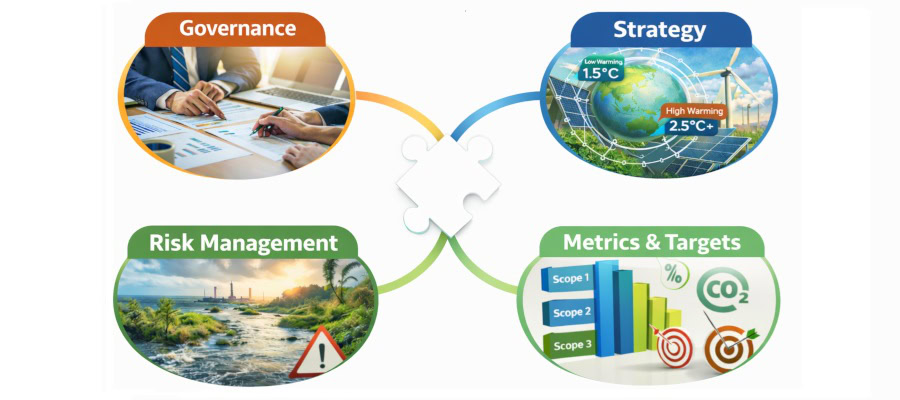
The standard requires disclosure across four core content areas to explain how climate change impacts the entity’s cash flows and financial performance:
Core content 1: Governance
Entities must disclose the governance processes, controls, and procedures used to monitor and manage climate-related risks. This includes identifying which board committee or individual has explicit oversight and how that oversight is reflected in the entity’s terms of reference or delegated authorities.
Core content 2: Strategy (and scenario analysis)
AASB S2 requires a “climate-related scenario analysis” to assess how climate-related risks (both physical and transition) and opportunities affect the entity’s business model, value chain, and financial planning. Under RG 280, entities must model at least two climate scenarios:
- Low warming: A scenario aligned with the Climate Change Act 2022 (limiting warming to 1.5°C).
- High warming: A scenario where warming well exceeds 2°C (ASIC specifies 2.5°C or higher).
Disclosure is required on how climate-related risks (both physical and transitional) and opportunities affect the entity’s business model, value chain, and financial planning. A key requirement is the use of climate-related scenario analysis to assess the entity’s climate resilience under different climate developments.
Core content 3: Risk management
Entities must describe the risk management process for identifying related risks and opportunities, including climate related physical risks (like floods) and climate related transition risks (like carbon pricing).
Core content 4: Metrics and targets
This requires the disclosure of information related to cross-industry metric categories, and targets that have been set by the entity, or targets required to be met, to mitigate or adapt to climate-related risks or take advantage of climate-related opportunities. Information must be provided about:
- Scope 1 & 2 emissions: Direct and energy-indirect emissions.
- Scope 3 emissions: Value chain emissions (including financed emissions for financial institutions and those in asset management).
As part of the scope 3 emissions, an entity must evaluate its value chain against the GHG Protocol Corporate Value Chain (Scope 3) Standard, disclosing disaggregated data for any of the 15 categories deemed material.
Notes:
- Entities applying for a standard for the first time has a one-year relief period for Scope 3 emissions.
What must a reporting entity prepare?
A new ‘sustainability report’ in the annual report
A core feature of the reforms is the requirement to prepare a sustainability report.
It is a regulated report that must be contained within the entity’s Annual Report (Chapter 2M). It must sit alongside the entity’s financial statements and form part of the overall mandatory reporting package for the relevant reporting periods.
The sustainability report is now considered as the “fourth report”, sitting alongside the Financial Report, Directors’ Report, and Auditor’s Report.
The sustainability report must include:
1. Climate statement
Climate statements for a financial year must disclose the entity’s material climate-related financial risks and opportunities, the climate-related metrics and targets required under AASB S2 (including Scope 1, 2 and 3 greenhouse gas emissions), and relevant information about the entity’s governance, strategy, and risk management in relation to those risks, opportunities, metrics and targets.
2. Notes to the statement
Explaining methodologies and assumptions supporting climate related disclosures.
3. Directors’ declaration
A signed declaration stating that the report complies with the Corporations Act and relevant Australian sustainability reporting standards.
For the first three years, directors only need to declare that the entity took “reasonable steps” to ensure the report complies with the standards. After 2028, this reverts to a full “compliance” declaration.
Sustainability reports must be lodged with ASIC within 3 months of year-end for disclosing entities, registered schemes and RSEs, and 4 months for other reporting entities.
RG 280 reinforces that this is a regulated filing, not a corporate communications document, and that entities should assume disclosures may be tested for substantiation.
ASIC guidance: What the Regulator expects
ASIC’s RG 280 explains how it will administer the new sustainability report requirements. ASIC expects each sustainability report to be entity-specific and evidence-based. A key operational requirement is the need to keep written sustainability records supporting methods and assumptions for seven years.
Protections: The “Safe Harbor” (modified liability)
To encourage transparent reporting during the early stages, the government has introduced a three-year modified liability period.
However, RG 280 cautions that modified liability settings generally do not extend to voluntary sustainability statements beyond what the standards require, or statements republished outside the sustainability report, unless required under Commonwealth law.
Between 2025 and 2028, directors and entities are protected from legal action (other than criminal action, or action by ASIC) regarding:
- Scope 3 greenhouse gas emission disclosures.
- Climate scenario analysis modelling.
- Climate related targets and transition plans.
How EnviroLaw can support compliance
As mandatory sustainability reporting obligations expand across financial years, the Australian accounting standards board requirements and sustainability report summaries will be incorporated into our environmental obligations directory, EnviroLaw. This will help you manage assurance requirements and Australian sustainability disclosure planning.
If you would like to add EnviroLaw to your current subscription to help manage your next sustainability report, get in contact with your Account Manager.
If you don’t have an Environment Essentials subscription, but are interested to see how our products can help you understand and prepare for the climate-related financial reporting requirements, get in touch or sign up for a free trial.
References:
- AASB Publication: ASSA 5000 General Requirements for Sustainability Assurance Engagements
- AASB Publication: ASSA 5010 Timeline for Audits and Reviews of Information in Sustainability Reports under the Corporations Act 2001
- AASB Publication: AASB S1 General Requirements for Disclosure of Sustainability-related Financial Information
- AASB Publication: Australian Sustainability Reporting Standard AASB S2 Climate-related Disclosures
- AASB Publication: Explanatory Statement ASSA 5000 General Requirements for Sustainability Assurance Engagements and ASA 2025-2 Amendments to Australian Auditing Standards
- AASB Publication: Explanatory Statement ASSA 5010 Timeline for Audits and Reviews of Information in Sustainability Reports under the Corporations Act 2001
- AASB Publication: An Overview of Australian Sustainability Reporting Standards
- AASB Webpage: Climate and Sustainability Assurance Requirements Approved
- AASB Webpage: Sustainability Reporting Standards
- ASIC Media Release: ASIC Urges Businesses to Prepare for Mandatory Climate Reporting
- ASIC Publication: Regulatory Guide 280 (RG 280): Sustainability Reporting
- ASIC Webpage: How and When to Lodge Your Sustainability Report
- ASIC Webpage: Sustainability Reporting
- ASIC Webpage: Sustainability Reporting for Small Business
- ASIC Webpage: What Should Your Sustainability Report Contain?
- Clean Energy Regulator Webpage: Assess Your Obligations
- Greenhouse Gas Protocol Publication: Corporate Value Chain (scope 3) Accounting and Reporting Standard
- Commonwealth Legislation: Treasury Laws Amendment (Financial Market Infrastructure and Other Measures) Bill 2024 Explanatory Memorandum
- IFRS Publication: IFRS S2 Climate-related Disclosures