Complying with council laws in Australia and New Zealand
Businesses are usually well aware of the need to comply with environmental requirements set out in federal and state legislation. However, it can be less obvious that legal obligations for businesses can also be found in laws made by local councils.
Everyone in a council area must comply with such laws and may face penalties for non-compliances. Therefore, it is important to understand how they might impact your business.
An overview of council laws
Council laws (also known as local laws or by-laws, depending on the jurisdiction) cover matters relevant to residents and business owners in the local community. They help manage public health and safety, council property, the environment and local amenity, and can be adapted to reflect the specific needs of the area that would be too difficult for the state or federal government to regulate. For example, the needs of residents and businesses in a rural location will differ to those in the inner-city, and having local laws specific to those areas can ensure that these are adequately addressed (e.g. laws for burning off vary significantly in inner-city vs rural councils).
All Australian states and territories have laws enforced by councils, except the ACT and NSW. The ACT does not have local councils, as the roles typically given to councils are instead covered by the territory government. NSW has local councils; however, activities that require approval from the council are outlined in the Local Government Act 1993 rather than council laws.
It is important to note that councils in New Zealand also have district and regional plans, in addition to by-laws. Councils are required to prepare these plans under the Resource Management Act 1991 to help manage environmental resources in their area, including the land, coast, air and water. They outline what activities can be undertaken in an area and whether they require a specific permission, such as a resource consent.
Councils are given the power to make and enforce their laws under the relevant state or territory Local Government Act, and in the case of New Zealand, the Local Government Act made by Parliament. The process for creating a council law varies by jurisdiction, however this usually involves a period of public consultation, allowing the local community to have their say and help shape the development of the law. Official notice must also be given when a new law is published and adopted, which can generally be found in the jurisdiction’s Government Gazette or on the relevant council website.

Environmental responsibilities of councils
Councils have a key role in managing the local environment and ensuring its protection. This is especially important as impacts from climate change are becoming increasingly apparent at a local level.
Councils investigate and provide permits for activities that may harm the environment, and are responsible for environmental matters such as:
- controlling pests and weeds
- managing waste and litter
- monitoring and investigating nuisances such as noise, odour and smoke
- planting and maintaining trees, including in parks and gardens
- regulating land use and planning.
Many councils also actively promote sustainability in the local area, develop environmental plans and policies, and aim to reduce environmental impacts within their own operations and buildings.

Environmental obligations imposed by councils
Councils also manage the environment by imposing environmental obligations on all residents and businesses in the local area through council laws. These obligations will vary across jurisdictions and councils; however, issues that are commonly covered include:
- activities on council-owned land, facilities and roads
- keeping animals
- licences and permits for various activities
- lighting fires and burning
- littering
- managing environmental impacts on building sites
- maintaining trees and plants
- native animals and plants
- noise
- nuisances
- pests
- pollution and emissions
- stormwater
- trade waste
- waste management
- wastewater
- water use.
While council laws are generally associated with rules for residential premises, such as noisy neighbours, pets causing nuisance, or putting bins out for collection, many environmental obligations also apply to business premises. For example:
- correct disposal of wastes, including:
- commercial and industrial waste
- general waste from locations such as offices
- trade waste and other liquid wastes
- preventing pollution to land, water and air from operations
- minimising nuisance from sources such as lighting, noisy equipment, odour, smoke, dust or other emissions
- preventing damage to vegetation and protecting animals when working on land.
It is also important to check if any activities you are planning to undertake require a licence or permit under any council laws and apply to the council as necessary.

Find your council
Copies of council laws, as well as consultations on proposed laws, are available on the relevant council website. To find your local council website and contact details, see:
- New South Wales: Council Links
- New Zealand: Council Websites
- Northern Territory: Find Your Council
- Queensland: Local Government Directory
- South Australia: Councils List and Map
- Tasmania: Council Directory
- Victoria: Know Your Council
- Western Australia: Local Government Directory
Many councils provide guidance or run programs and events for local businesses looking to improve their sustainability and reduce their impact on the environment. These cover topics such as the circular economy, energy efficiency, reducing greenhouse gas emissions, renewable energy and waste management. Additionally, grants may be available through the council to help businesses achieve their sustainability goals. Check your local council’s website for details of these initiatives.
Stay informed with EnviroLaw
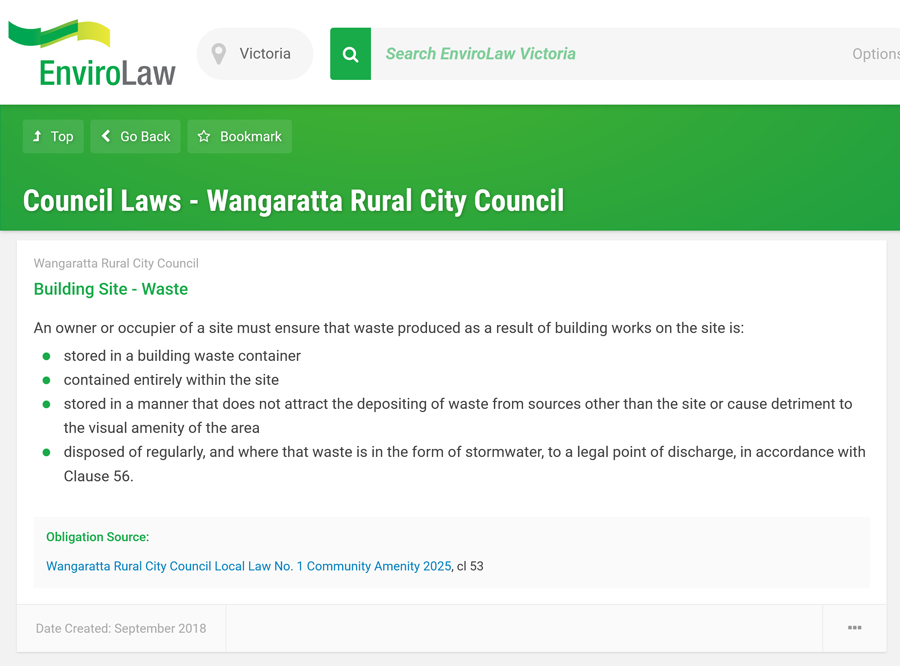
To help you understand your obligations under council laws, every jurisdiction in our EnviroLaw directory (except ACT and NSW) has a dedicated Council Law section, which includes plain-English summaries of environmental requirements from relevant council laws. Additionally, any new or changed council laws will be notified in our monthly EnviroLaw updates, allowing you to stay up to date with the latest requirements.
If you don’t have access to these summaries or an EnviroLaw subscription, contact our sales team or sign up for a free trial.
References
- Department of Housing, Local Government and Community Development Webpage: Local Government Act 2019
- Department of Local Government, Industry Regulation and Safety Webpage: Local Laws
- Department of Premier and Cabinet Webpage: About Tasmanian Councils
- EPA SA Webpage: General Environmental Obligations
- EPA Victoria Webpage: Industry Obligations
- EPA Victoria Webpage: Who we Work with
- Far North District Council Webpage: Let’s Talk About Bylaws
- Hutt City Council Webpage: How we Create Bylaws
- Legal Services Commission SA Webpage: Local Government
- Legislative Assembly for the Australian Capital Territory Webpage: The ACT in Australia’s Three Levels of Government
- Local Councils SA Webpage: Environment and Sustainability
- Local Councils SA Webpage: Local Laws and Permits
- Local Government Victoria Publication: Guidelines for Local Laws Resource Book
- Local Government Victoria Webpage: Local Laws
- Ministry for the Environment Webpage: All About Plans
- Ministry for the Environment Webpage: Councils, Plans, and the Resources They Manage
- Northern Territory Government Webpage: How Councils Operate
- Parliamentary Education Office Webpage: Explore the Three Levels of Government
- Parliamentary Education Office Webpage: Three Levels of Government – Governing Australia
- Queensland Government Publication: What is a Local Law?
- Queensland Government Webpage: Local Government Laws Across Queensland
- Vic Councils Webpage: Council Roles
- Vic Councils Webpage: Environment
- Vic Councils Webpage: Health and Safety
- Vic Councils Webpage: Local Laws & Permits
- Vic Councils Webpage: Parks & Gardens
- Vic Councils Webpage: Pets & Animals
- Vic Councils Webpage: Planning & Building